A Billion Minds, One Unasked Question: What Are We Actually Building?
India carries millennia of knowledge, a billion minds ready to lead and a habit of thinking too small. It is time we changed that.
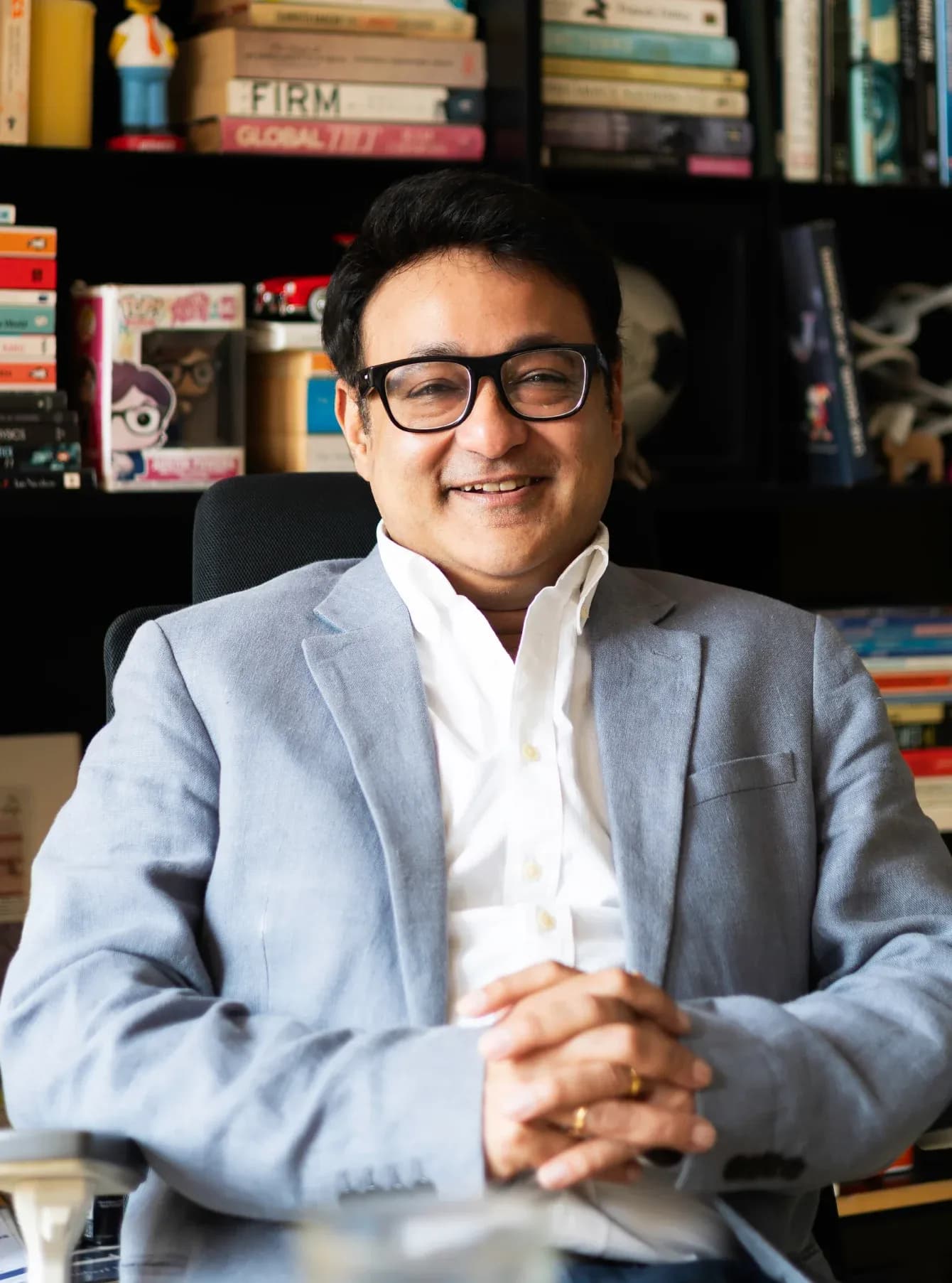
Gaurav Gaggar
Leading voice in India’s startup ecosystem
Last week I sat in the audience at my daughter's annual school day. The theme the children had chosen was striking: mythology, machines, and mind — which of the three is the wisest guide? A child stood at the podium and spoke about the Ramayana, about Ram's choices, about the values encoded in those ancient stories. Another spoke about machines, about how technology has always pushed humankind forward. And then came the quiet, powerful punchline: it is the mind that governs everything — past, present, and future. It binds mythology and machines together. Sitting there, I realised that this is precisely the question One Big Future exists to answer: how do we bring all three together for India, right now, at this particular moment in history?
I should be honest about something. There is a pattern I have watched my entire life, the one I have been part of myself. Growing up in middle-class India, we were taught to be careful. To stay within the lines. To take the safe path, to be grateful for what we had, and not to reach for anything audacious. That lesson came from a good place. But somewhere along the way, it also taught us not to be explorers. Not to be risk-takers. Not to be the kind of people who discover what has not yet been discovered.
"If you don't take risks, you limit yourself, and you limit your race. A civilisation that stops exploring is a civilisation that begins to disappear." Some of this is historical. For centuries, we were governed by others who told us how to think, what to build, what to value. The consequence is that we have been cautious when we needed to be courageous. And yet, I also know that caution is not the full story of India. We had nuclear physics, quantum thinking, precision medicine. Knowledge that predates the West's claim to these fields by centuries. That knowledge got lost, but the capacity for it never did.
Why We Cannot Think in Sectors Anymore
When I look at India today, as an entrepreneur and as an Indian, what I see clearly is that the great challenges and the great opportunities do not respect sector boundaries. They never did. You cannot solve education without solving healthcare. You cannot lead in manufacturing without confronting climate. You cannot build genuine national security — food security, climate resilience, defence capability — without a unified strategy that understands how everything connects. We have been thinking in silos. I know this because I have watched it happen at close range. When I incubated a startup back in 2013, tracking deep tech alongside colleagues from across industries, what became obvious very quickly was that a company working in liquid biopsy or robotic surgery inevitably found itself also looking at advanced materials. Which led it to compute efficiency, which consequently led it to AI. The core dependencies run everywhere. There is no such thing as a sector-specific solution to a civilisational problem. There is only one blanket and we must learn to move it together.
The Applied AI Opportunity India Cannot Miss
The global conversation about artificial intelligence has been dominated by the question of large language models — the giants that cost trillions of dollars to build, and that India, frankly, cannot yet afford to develop at scale. We do not have an LLM. That is both a constraint and, if we read it correctly, a signal. What we can build and what very few nations are positioned to build are sandboxed, domain-specific AI systems. Targeted intelligence for Agri-tech. For bio-tech. For oil drilling and climate modelling. For the logistics of a 1.4-billion-person nation. For garment manufacturing and urban water infrastructure. These are not consolation prizes. These are the applied AI opportunities that translate directly into livelihoods, into resilience, into export-ready capability. And we have the workforce, the engineering talent, and the on-ground need to build them faster than almost anyone. Let me be clear about one thing: AI will not solve everything. It will make us more efficient. It will accelerate discovery. It will collapse the time it takes to find a new molecule from years to weeks. But human intelligence must remain on top, not to do the arithmetic, but to ensure the inputs are correct, that the outputs are not hallucinating, that the thing being optimised is actually the right thing to optimise. That judgement is irreplaceable.
On Intellectual Property and What We Are Giving Away India hosts some of the world's most significant international technology companies. Their teams here are talented, driven, and doing genuinely innovative work. And almost all of that innovation — the intellectual property, the patents, the data, the value — leaves the country. It is registered elsewhere, owned elsewhere, monetised elsewhere. I have proposed to the Government of India a specific policy idea: a national IP data bank and an exchange. A place where scientists, innovators, and entrepreneurs can list their intellectual property and where investors and companies can discover and fund it. The problem in India is not a shortage of ideas. It is the absence of a robust system to move from idea to IP to monetisation to global market. We need that pipeline. "The services wave carried India to the world. The next wave must carry Indian-owned innovation to the world — built here, owned here, exported from
here."
Bringing the Future to the Common Person
One of the founding commitments of One Big Future is to bridge the gap between where innovation happens and where people actually live. Right now, too much of what we discuss in think tanks and policy circles never reaches the street. The common person receives whatever is handed down and often has no idea why, no context, no ownership of the decision.
The answer starts with education but not education as we currently practise it. Why, in 2026, a grade 10 child still memorising the name of an incomplete nuclear facility in a geography textbook? Instead, show that child a video. Let them see the facility, understand what it does, ask why it matters. Arouse their curiosity. That is education.
The memorisation of inert facts in a world where every fact is accessible in seconds is not education, it is a ritual we have confused for learning. And then there is skilling. Consider the plumber. Today, a plumber is dispatched to fix a
leak. But what if a plumber were taught in Hindi, using a simple AI tool on a phone to model the entire plumbing layout of a building? To understand water flow, pressure, waste management, efficiency? You do not need an engineering degree for that anymore. AI handles the calculation. The human brings the judgement, the physical skill, the contextual knowledge of that specific building. The plumber becomes a systems thinker. The electrician becomes an energy auditor. The carpenter becomes a structural designer. This is what applied AI for the common person looks like. It is not theoretical.It is available now.
Why One Big Future Exists
India does not need another conference. It does not need another white paper that sits on a ministry shelf. What it needs, what I believe we have the moment and the mandate to build - is a living, working platform for holistic thinking and coordinated action. A space where education reformers sit with AI engineers. Where climate scientists sit with manufacturing entrepreneurs. Where policy makers sit with plumbers who have ideas about water systems. Where the question is not "what does your sector need?" but rather "what does India need, and how do all of us get there together?" One Big Future is that attempt. It is a conviction that the thinking must be as large as the problems we face and that implementation, not conversation, is the standard by which we measure ourselves. We are a nation of over a billion people, with an ancient tradition of knowledge, a young and growing talent base, and a technology window that is open right now. The window will not stay open forever.
Mythology taught us values. Machines expand our reach. The mind — the collective Indian mind, freed from the habit of thinking small — is what will determine whether we lead or follow in the decades ahead. This is our moment to ask the one big question. And to build the one big answer.
Gaurav Gaggar
Leading voice in India’s startup ecosystem
Gaurav is a leading voice in India’s startup ecosystem, known for incubating and successfully exiting multiple ventures. He is the Founder & COO of T9L, a full-stack venture studio that builds and scales IP-led businesses through a structured value-creation framework. A Chartered Accountant with experience at Deloitte and Citi, he specializes in IP, finance, policy, and legal strategy, enabling startups and enterprises to navigate risk and capitalize on opportunities in India’s evolving digital economy. Passionate about innovation, Gaurav advocates progressive IP frameworks and legal reforms that unlock new business frontiers and help companies operate in regulated environments.
0 Comments
- No comments yet. Be the first to comment.
You Might Like
Stories and perspectives from leaders shaping India’s long-term future.